
- 02-07-2020
- 08:00
- timer 5 minutes
ERP ‘all-in-one’ versus ‘Best of Breed’
Which will your company choose? Using a single ERP ‘all-in-one’ system, or using a range of different software applications that integrate with each other, ‘best of breed’? This blog explains what ‘best of breed’ and ERP ‘all-in-one’ are and what their pros and cons are.
In this article:
- What is ERP ‘all-in-one’ software?
- What is 'Best of breed' software?
- ‘Best of Breed’ or ERP ‘all-in-one’?
What is ERP ‘all-in-one’ software?
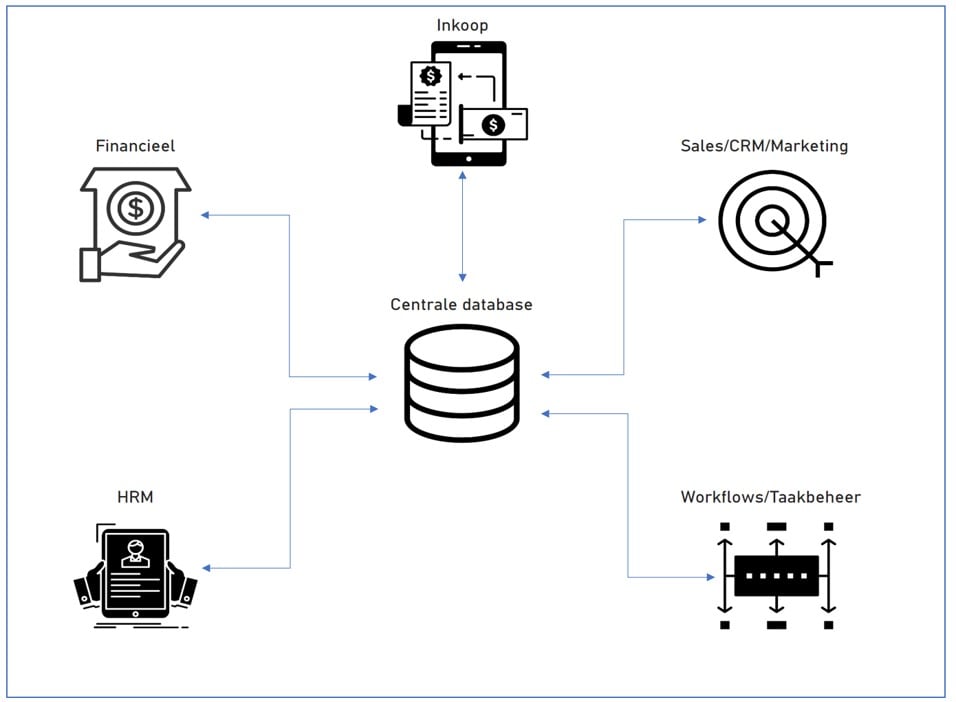
The terms ERP system, ERP package and ERP software are often used interchangeably. ERP stands for ‘Enterprise Resource Planning’. In an ERP system all primary and secondary business processes are integrated with each other. From CRM, project management, order management and inventory management to HRM, payroll and financial administration. All business processes (logically) connect with each other, because everything is built from one system. In addition, all information flows are stored in one database and all employees work from the same system.
You also often see with ERP systems that ‘almost’ anything is possible in terms of features, but that it often takes a lot of time and money to make this ultimately possible. Consultants often still have to be brought in to get the features working optimally. In addition, (because it has so many possibilities) a lot of time has to be put into maintaining the software.
Below is a visual representation of an ERP ‘all-in-one’ system:
Below are the pros and cons of an ERP ‘all-in-one’ system
Benefits of ERP ‘all-in-one’ software:
+ Uniform way of working
All employees work with the same system, which makes it easy to apply a uniform way of working.
+ Seamless integration between business processes
The business processes often connect (seamlessly) with each other, because everything is done from one system.
+ Information in one place
Data is stored in one database, so all information is in one place. This makes it (more) straightforward to create (management) reports.
Drawbacks of ERP ‘all-in-one’ software:
- Time-consuming
It often takes a lot of time to implement a complete ERP system, because features often have to be tailored to the specific wishes of an individual company.
- High investment
Because it often takes a lot of time to get an ERP system fully up and running, the investment is often high. The development, implementation and maintenance of ERP software require a high investment.
- Process dependency
It can happen that something has to be changed in a certain process, which can then mean that something no longer works in the following process.
- Supplier dependency
The software comes from only one supplier, and you are dependent on them.
Tip
To see whether an ERP system is worth the investment, it can be useful to make a price comparison.
What is 'Best of breed' software?
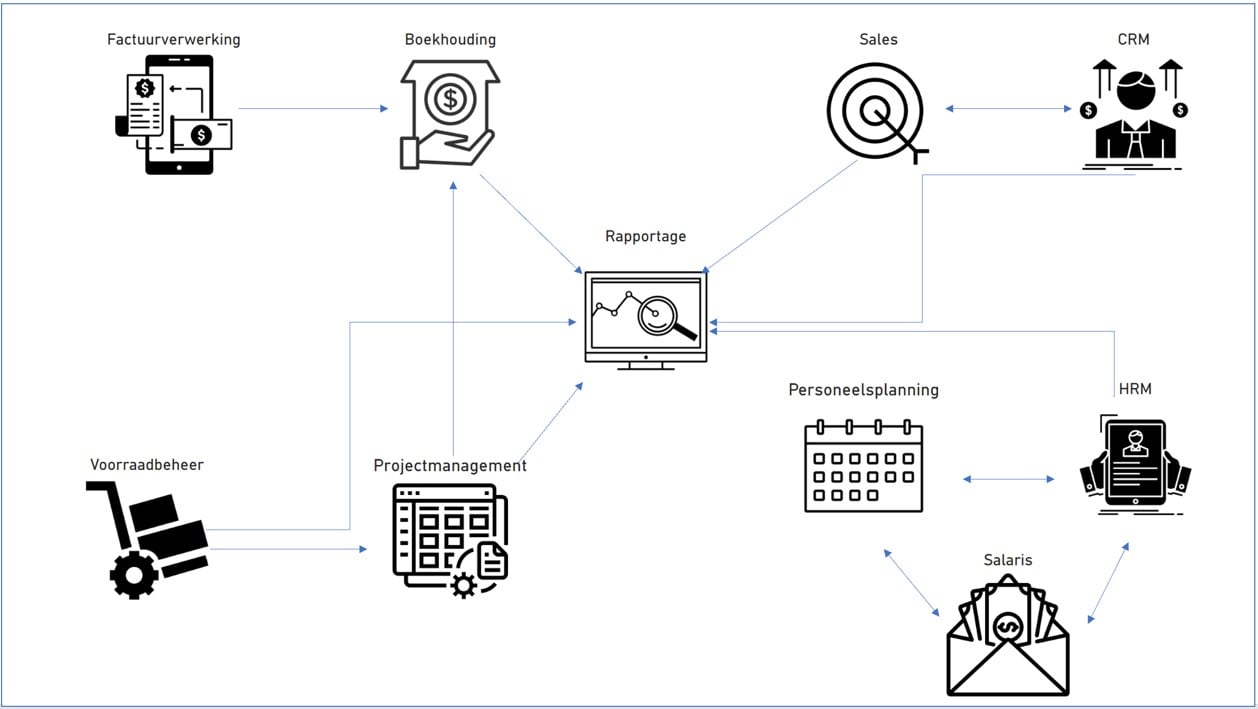
‘Best of breed’ software is the opposite of an ERP ‘all-in-one’ system. It means that for every task that has to be carried out in an organisation, the ‘best’ available software is used. ‘Best of breed’ solutions are all separate SaaS (Software As A Service) solutions, which are often linked to each other.
In theory this means that the sales department works with the best sales and CRM software, while the HRM department uses the most ideal HRM software. In this case the software can come from different software suppliers. Employees therefore work in different systems. But this often does mean that these ‘Best of breed‘ solutions offer all the features that a particular department wants. In this way, as a company you can create an optimal software landscape.
Below is a list of characteristics of SaaS solutions:
- Accessible anywhere
The user has access to the software via the internet 24/7.
- Maintenance and management by the SaaS provider
The SaaS provider is responsible for the management, maintenance and security of the software. Updates, backups and security are provided by the SaaS providers.
- Pay for use
The user does not have to buy the software, but pays for using the software. You often pay monthly or annually per user or per module. This means a high one-off investment is often not needed.
- No customisation
The software is not built for individual companies, but for all users. Individual adjustments can only be made to the software within a certain range. All users work with the same software version. So if a new software update takes place, it applies to all users.
- Short implementation time
Another characteristic of a SaaS solution is that it takes little time to get it running, because it is immediately accessible to everyone. Implementation therefore takes relatively much less time.
Below is a visual representation of a ‘Best of breed’ software landscape:
Benefits of ‘best of breed’ software:
+ De ‘beste’ features
‘Best of breed‘ solutions often offer all the features that a particular department wants. In this way, as a company you can create an optimal software landscape.
+ Easy to manage
The SaaS provider is responsible for the management, maintenance and security of the software. As a company you therefore do not have to do any management.
+ Automatic updates
The software is updated regularly
+ Low investment/short implementation time
Because the software ‘already exists’, relatively little cost has to be incurred for implementation.
Drawbacks of ‘best of breed’ software:
- Monthly/annual costs can add up
By purchasing a large number of different SaaS applications, subscription costs can add up quite quickly.
- Not all SaaS applications integrate well with each other
Software applications can exchange data with each other by means of APIs. Not all SaaS applications integrate with each other as standard. The drawback is that data from one system does not match up with another system.
- No single central database
There is no single central database in which all data is stored. This can make it harder to create reports.
In practice
In practice this is often solved by means of a data warehouse. A data warehouse is a system built to support analysis. The data is extracted from the various SaaS applications and then stored in the data warehouse. A software solution for analysis and reporting then retrieves its data from the data warehouse in order to create reports.
Conclusion: ‘Best of Breed’ or ERP ‘all-in-one’?
So it is hard to say what the best choice is for your company. As described, there are pros and cons for both variants.
If you would like help putting together an ideal software landscape, please contact us.
Software advice from SoftwareWatcher
Do you need advice on the best software? Get in touch now and we will draw up a list of the best software for your organisation.
Non-binding and without obligation